


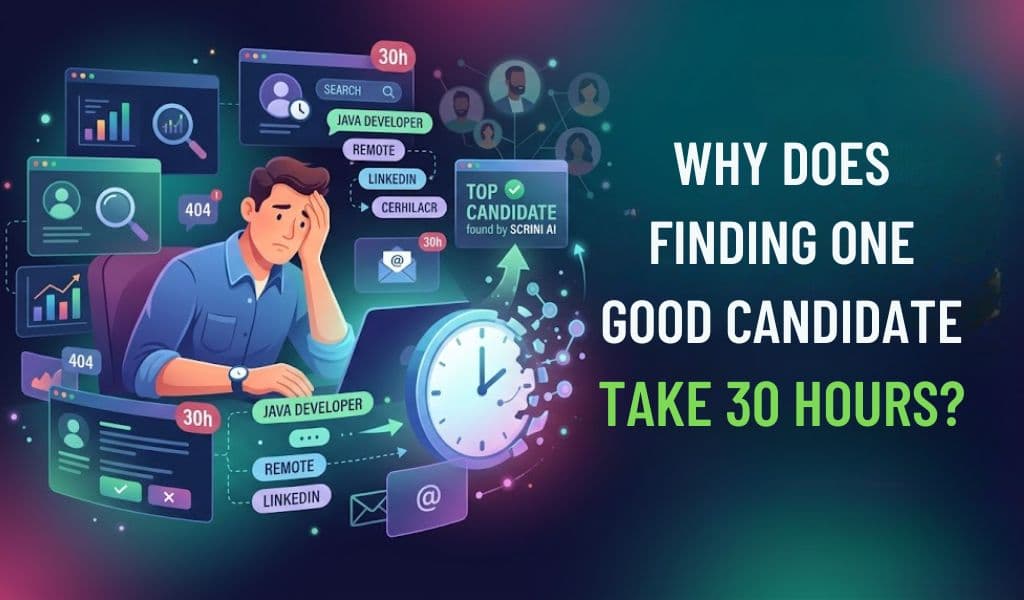
Why Does Finding One Good Candidate Take 30 Hours?
Between 30 open tabs and endless copy-pasting, the human part of recruiting gets lost. Here is how to stop the manual data drain and get your week back.
In this article
Let’s face it: you didn’t get into talent acquisition to become a professional copy-paster. Yet, between jump-scaring yourself with thirty open browser tabs, tracking down email addresses, and writing the same "Hey there!" message fifty times, the actual human part of recruiting often gets shoved to the side. Modern recruiter burnout isn't a lack of hustle; it's a structural workflow problem. This post breaks down where your hours are vanishing and how to steal them back without letting your pipeline run dry.
1. The Cost of Context Switching
Every time you hop from LinkedIn to GitHub, then over to a portfolio site, and finally into your ATS, your brain pays a hidden tax. Studies show it takes upwards of 20 minutes to refocus after a disruption.
When you spend your morning bounce-hopping across platforms just to verify if a candidate is a good fit, you aren't just losing time, you're draining your mental energy before you ever pick up the phone.
2. Reading Between the Lines (The Hard Way)
Sifting through hundreds of profiles to find niche talent is a massive bottleneck. Most traditional platforms require you to manually build complex Boolean strings, only to serve up candidates who updated their resumes three years ago.
You end up playing digital detective, looking for minor profile updates or subtle activity signals to guess if someone is open to a new role. It's a guessing game that eats hours and yields frustratingly low response rates.
3. Delegation, Not Replacement: Enter Agentic AI
The solution isn't to work longer hours, nor is it to spam candidates with generic, robotic automation. It’s about offloading the data-shoveling to a dedicated assistant.
This is exactly why we built Scrini AI. Instead of you jumping across ten tabs, Scrini acts as an autonomous sourcing agent. It reads the open web, crosses data silos, tracks real-time availability signals, and hands you a curated list of top-tier talent with clear reasoning for every fit score.
By automating the heavy investigative digging, you slice that 30-hour sourcing drain down to a fraction of the time. You retain absolute control over the final outreach, but the digital legwork is completely taken care of.
Conclusion
Recruiting is fundamentally a relationship business, but you can't build relationships if you're drowning in manual data entry. Reclaiming your week means recognizing that your time is best spent talking to people, not managing browser tabs. By shifting from manual hunting to AI-powered curation, you can beat the burnout and get back to what you do best: hiring great people.
Ready to see what an extra 20 hours a week feels like? Book a quick demo with Scrini AI today and watch our autonomous agents do the heavy lifting for you.